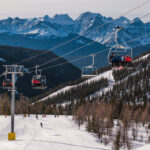
This winter, Mt. Norquay turns 100—the Canadian Rockies’ oldest ski resort, and the local favourite for its world-class race programs, clubby family vibe, and a tubing park that’s gone viral. But the real reason to ski Banff’s Norquay this season? The Big Chair. Ride it while you still can.
Installed in 1948, the North American Chair—“Big Chair” to anyone who’s skied it—was Canada’s third-ever chairlift and served the steepest, longest terrain in North America at the time. With classic single seats serving pitches reaching 40-degrees, it was quite the ride. Its current incarnation—a 1966 upgrade to two-seaters—reduced line-ups and meant one could ski on Sundays without missing church.
Norquay’s Vision
Maintaining the Big Chair still demands parts from the back of a warehouse in Switzerland and the love of a classic-car mechanic. It’s where locals earn their chops and where “once you’ve skied Big Chair, you can ski anything” isn’t just talk from Norquay’s GM Andre Quenneville—it’s the alpine truth.
But its days are numbered. As part of Norquay’s 100-year vision board, the beloved Big Chair will be retired in 2026 and replaced by a new two-stage gondola and a soon-to-be zhuzhed-up Cliff Tea House. Doubtless sleek and modern, but the end of a cool aesthetic, too.
How it Began
It all began in 1926, when ski pioneer Gus Johnson cleared the first trails above Banff. Skiers rode (or were dragged by) the first lift—a Chevy-powered rope tow built in 1941—for 25 cents for four rides. Soon, Norquay was hosting slalom races with elite European teams, Dominion races and, by 1972, Gustavo Thoeni had won a World Cup slalom there.
A wave of post-war European immigrants brought alpine expertise and seriously snazzy stretch pants, turning Norquay into Canada’s proving ground. Tuques off to a foundation-building cast of Norquay characters too great to mention but here’s a start: Internationally renowned alpine photographer Bruno Engler; Bob Rankin, a.k.a. the Mountain Smoker, who set a record with 24 laps in three hours on the Big Chair; World Cup racers the Monod brothers, Ken Read, Karen Percy and the Bosinger brothers; heli-ski pioneers Hans Gmoser and Mike Wiegele; Canada’s first heli-ski pilot, Jim Davies; and National Team coaches Scott Henderson and Bruce Henry.
Legacy of Rudi Gertsch
Perhaps the most iconic memory of Norquay involves Purcell Heli’s Rudi Gertsch. In the especially powdery winter of 1967, Gertsch famously jumped over the Cliff Tea House for Bruno Engler’s camera, leaving a tail of smoke in his wake. That moment was frozen in time for a 10-year-old Marty von Neudegg: “Rudi was our coach, and he had built a little kicker off the Tea House roof. He took off on his Fischer 210cm skis, went flying over the rail in a full split, and landed down in the bowl. I once told Rudi, when I saw him flying over my head, he became a god to me. He stayed our ski god forever.”
The annual Bruno Engler Race—Canada’s longest-running ski race—is another in a mountain of memories at Norquay. And the Big Chair stands at its heart—not just a lift but a rite of passage. So, one more lap up, one more burn down. Before a piece of Canadian skiing spins no more.
Leslie Woit’s article first appeared in the Fall 2025 edition of Ski Canada magazine.