THE CAMERA IN YOUR POCKET GETS BETTER
Isn’t this cheating?” Antoine yelled at me downslope.
With my iPhone in one ungloved hand, I was using the other to toss a snowball where I wanted my new ski buddy to make a nice C-shaped turn—and in which direction.
“Remember, it’s a photo, not a video,” I reminded him. “You only need to go fast enough to kick up some snow, not scream past me.”
Later, at après ski, the wide-eyed Calgary paediatric surgeon flipped through the sequence of pics asking: “Can I send these to my dad?”
The “cheating” Antoine was referring to was the fact we had stopped to set up the shot. For some reason, many people think that good ski photography is spontaneous. It’s not impossible to take a good spur-of-the-moment shot, but it’s rare.
Given virtually all of us ski with phones now, anyone can be a photographer. It just takes a little patience to snap an image you can proudly post on your fridge door or Instagram. And, as we all know, you don’t need to ski better, you just need to look better.
But how do you go beyond yet another static shot of you and your honey, or the gang lined up in helmets and goggles a mile from the photographer?
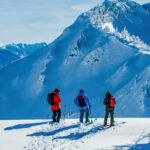
Start by scouting for a dramatic vista. Once that’s found, remember your phone likely now has telephoto capabilities. Worrying about other stuff like lighting and shadows, or the colour your model is wearing, can all come later. It takes time to set up a shot, so unless others don’t mind waiting, start with a smaller group size, or tell the gang you’ll catch up in a run.
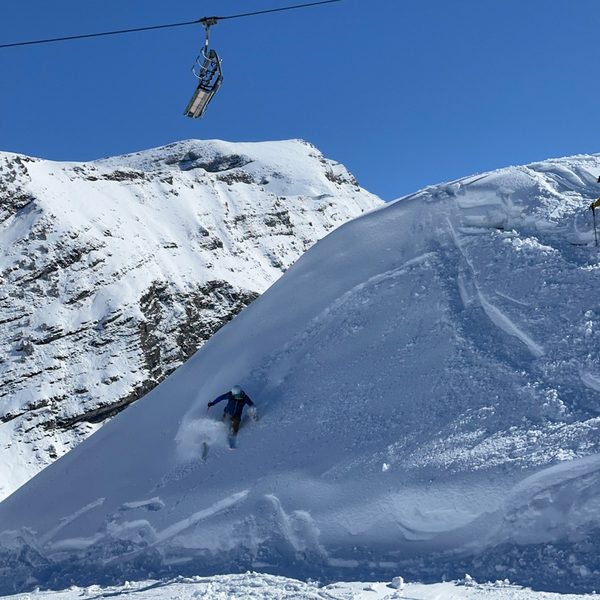
Use your phone’s telephoto to both crop out the foreground and bring the background closer.
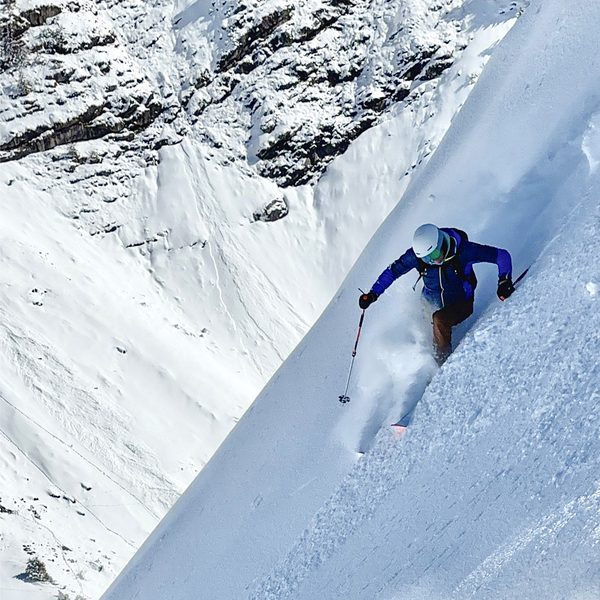
An untouched slope with a dramatic background can be found a few metres from a cat track.
THE SHOT IS IN THE SETUP
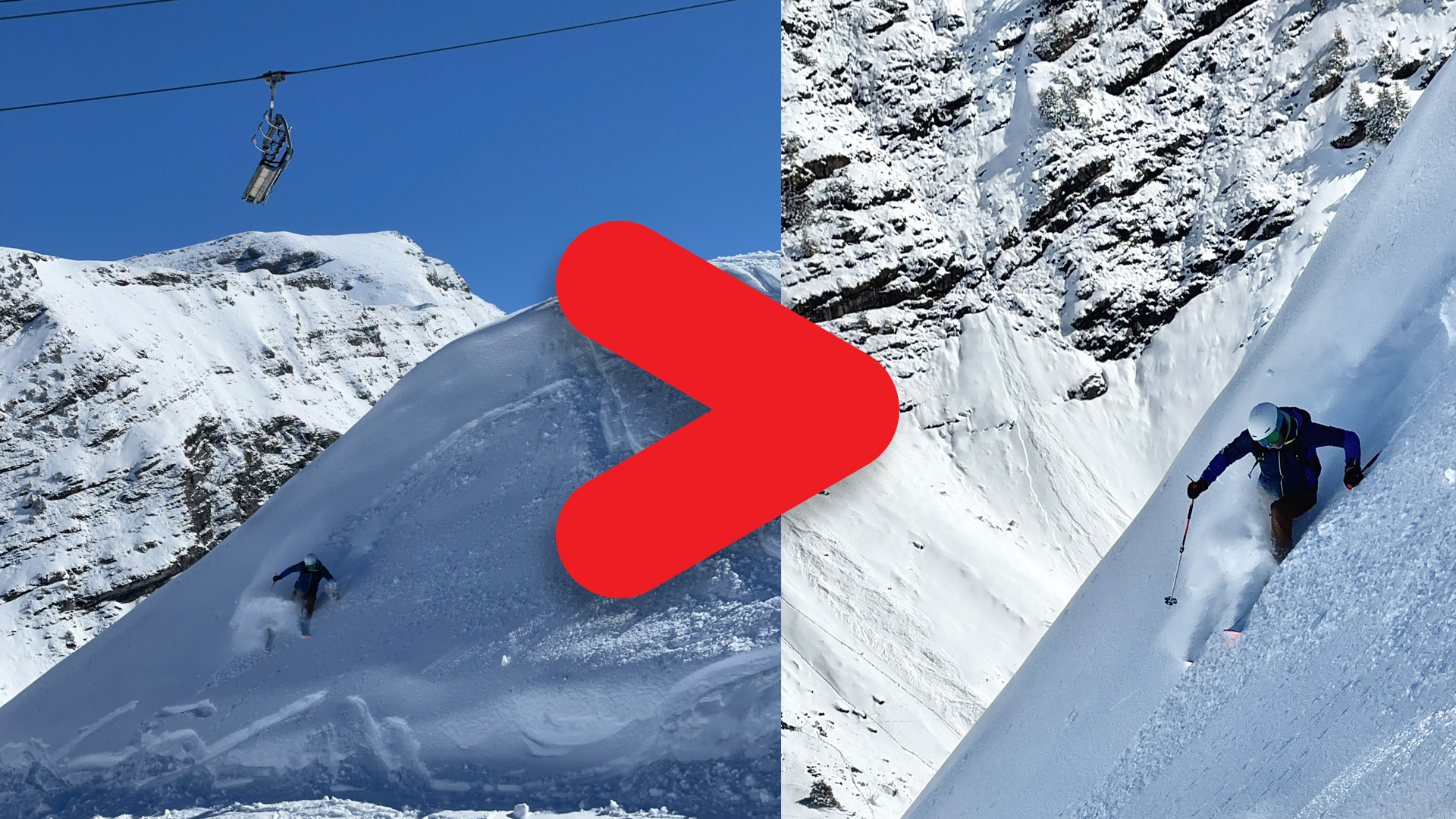
The money shot can often be found in unlikely places. You don’t need to be deep in the backcountry to snap photos that look like you are. The pics on this page, for instance, are the same scene shot two different ways. They were taken last winter on a crowded cat track leading to a lift at Champéry, Switzerland—part of the world’s largest ski domain, Portes du Soleil. My wife Ray and I literally had to wait for a break in the skier traffic. Meanwhile, with skis on his shoulder, we made our friend Alessio hoof it up just so he could make one single turn in untouched powder for our lenses.
With Ray standing only slightly behind me and, for this exercise, shooting at a wider angle, you can see how a dramatic scene can result in disappointment as the stunning backdrop gets lost in the distance (left). If you want your skier and background to appear closer together, and your phone has optical zoom capabilities, stand back and use your phone’s telephoto option to bring forward that mountain face, unique building or lift tower (right). Don’t wait until later to crop in close to show off the skier, it won’t make him or her appear closer to the background.
Along with Ski Canada’sannual Buyer’s Guide publishing in September, Apple launches its new models of iPhone 18 this year. As I was writing this, the rumour mill was churning out some expected improvements that skiers—or anyone shooting action photos and videos—will covet.
In what may be iPhone’s biggest hardware upgrade in years, larger, stacked camera sensors will hugely increase data readout speeds to better capture action photos. As well, a bigger and faster sensor with mechanical variable aperture will allow in more light for quicker shutter speeds and improved aperture control.
I don’t know why we call them “phones” when we use them far more as computers and cameras or in my case, to aid in memory of where, when and with whom I’ve been somewhere. But I do know that not having to drag around my comparatively priced and cumbersome DSLR camera and lens (which don’t work very well as a phone) have made my life a lot easier.